
Curriculum & Pedagogy
Our curriculum provides the framework of what we teach, while our pedagogy determines how it is taught. Pedagogy is the art and science of teaching, the why and how we craft our teaching practice in the way we do. It's what breathes life into our curriculum. Our pedagogy and curriculum work together to ground learning in real-world, nature-based experiences. At The Forest School, essential academic skills are developed, while curiosity, resilience, and joy in learning are nurtured.
The Forest School pedagogical approaches

Inquiry & Projects
Children’s questions and interests drive purposeful projects that deepen learning.
Learning in Nature
With no less than four hours outdoors each day, the environment is an active teacher.

Play-Based Learning
Unstructured play fosters independence, while guided play supports key skills.

Social-Emotional Learning
We help grow resilience, social skills, and positive wellbeing.

Foundations in Literacy & Numeracy
Explicit, research-based teaching builds strong academic skills.
Curriculum Overview
Literacy and Numeracy are explicitly taught every day, grounded in the science of learning and world-class research based frameworks. Social emotional learning is also taught with intention, nurturing character and social competencies. Inquiry weaves through all other learning areas, emerging from play, big questions, or moments of wonder. This creates a bespoke, enriching curriculum where subjects connect naturally, and literacy and numeracy are further strengthened across contexts.
Curriculum Learning Areas

-
We teach literacy in a structured way, explicitly building children’s skills in speaking, listening, reading, writing and spelling through step-by-step, evidence-based programmes that support every learner. Alongside these core skills, our Reggio Emilia approach ensures children also experience the joy of literature and written language: exploring rich, meaningful texts chosen from their interests and from high quality books offered by teachers. Stories are read aloud every day, used as springboards for inquiry and creativity, and celebrated through DEAR (Drop Everything And Read). Children also have opportunities to write freely and explore self-expression through journaling and book making. Literacy and Literature at The Forest School is not only about mastering core skills, but about developing a lifelong love of reading and writing.

-
As an Enviroschool, The Forest School places the environment at the centre of everything we do. Children learn as kaitiaki (guardians) through hands-on scientific exploration in both bush and beach settings, using a Reggio-inspired approach where curiosity drives discovery. They develop sustainable practices such as growing food, harvesting, rongoā, and companion planting, alongside Enviroschools actions like pest plant management, animal trapping, reusing and repurposing materials, and reducing waste. Working with parents and community partners like Forest & Bird, Garden to Table, and Restore Hibiscus & Bays, children, teachers, and whānau plan, design, and take action together to restore and enhance our environment.

-
Sign language and Te Reo Māori are woven into daily interactions and learning experiences as well as a variety of international languages. This creates an inclusive environment where many languages and cultures are celebrated, and children grow in their appreciation of diversity. By learning and using these languages together, our community becomes more connected, respectful, and empathetic.

-
We believe emotional connections are integral because children learn best when they feel safe, valued, and understood. At The Forest School and we place a strong emphasis on helping children grow their social and emotional skills alongside academic learning. Using the Social Thinking Methodology by Michelle Garcia Winner, we explicitly teach children how to understand themselves and others, build friendships, solve problems, and regulate emotions. We also draw on Habits of Mind by Costa and Kallick, which nurture dispositions such as persistence, empathy, and flexible thinking. Together, these approaches foster resilience, character, and respectful relationships, while aligning with the Key Competencies of the New Zealand Curriculum.

-
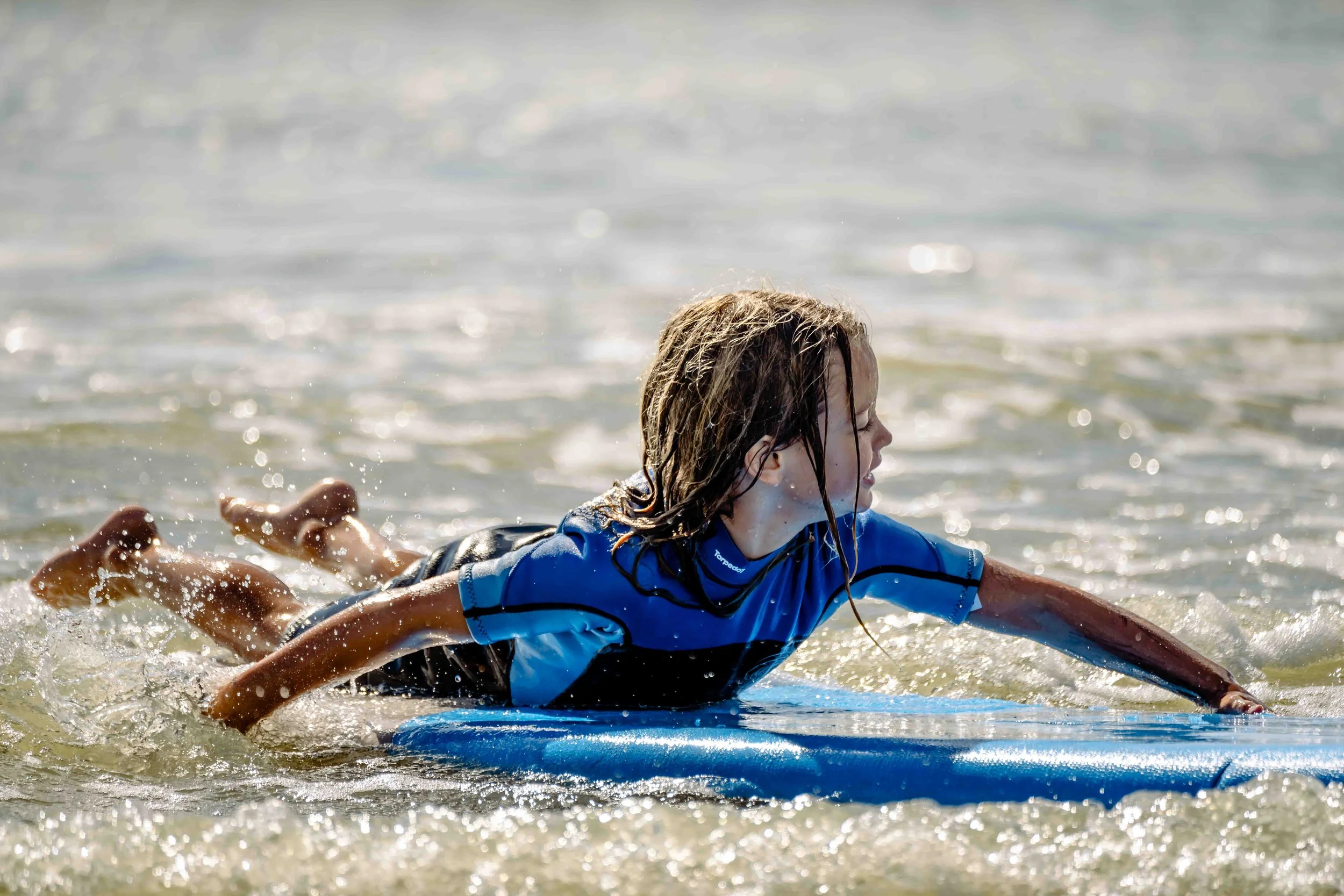
Children are physically active throughout the day to ensure they grow healthy and confidently. They spend at least four hours outdoors learning with their teacher and classmates, in play, exploration, games, and movement. Adventure learning is part of our curriculum, with opportunities such as orienteering, bushcraft, surfing, snorkelling and other safe, age-appropriate challenges that build confidence and resilience. We also offer swimming and surfing lessons and as our school grows will offer school sports teams. Our purpose-built bike pump track through the forest adds daily fun and challenge, with future plans for a skateboard area. Connecting with te taiao (the natural world) through physical activity is at the heart of how our children learn and thrive.
-
Maths is taught through a balance of explicit skill-building and joyful exploration. Using the Numicon programme, children are guided step by step in core numeracy skills such as problem-solving, reasoning and mathematical operations through hands on resources and visuals that make abstract concepts clear. Alongside this, our Reggio Emilia approach ensures maths is also discovered in meaningful, real-world ways: through inquiry projects, play, stories, and daily “Number Talks” that invite children to share and test ideas aloud. This mix of structured teaching and creative exploration helps children not only master essential maths skills but also see mathematics as relevant, enjoyable, and part of their everyday world.

-
At The Forest School, the arts are central to how children learn, create and express themselves. Our vibrant atelier (art studio) is a shared creative space that offers a wide range of materials and mediums where imagination can flourish and the “hundred languages of children” come alive. Visual arts, music, drama and dance are woven into inquiry projects, allowing children to explore ideas, tell stories, and work together through movement, rhythm, and sound. Through these opportunities, children develop creativity, confidence, and a lifelong appreciation for self-expression and the arts.

-
Children design, build, and innovate in creative ways that bring engineering, science, building and construction into real-life experiences. Using a wide range of hands-on tools and materials, they experiment, invent, and explore concepts such as design, physics, carpentry, chemistry and more. For us, technology does not mean devices, we are a predominantly device-free school, but we may use the internet purposefully as a tool for collaborative research and learning when it truly adds value. This approach helps children see technology as a way to problem-solve, test ideas, and create with purpose, rather than simply consume content.

-
This area of our curriculum is about celebrating Māori and Pasifika values and traditions while also recognising and honouring the many cultures that make up our wider global community. Children learn about different histories, arts, and perspectives, helping them appreciate the richness of diverse traditions and ways of life. We mark cultural events such as Matariki, Te Wiki o Te Reo Māori, Chinese New Year, Diwali, and other significant celebrations from around the world. In doing so, we foster an inclusive school culture where every child and family feels valued, supported, and proud of their cultural heritage.